


Goodbye to Frustration: Is Radical AI Automation Finally Delivering Good Customer Experience? was a panel at Tech.Weekend, part of the Weekend.19 festival in Rovinj, in September 2026. It brought together Ervin Jagatić of Infobip, Aleks Buvač of Own.Solutions and Mislav Galler of Telemach Hrvatska, and was moderated by Una Softić, CSO at Intertangible.
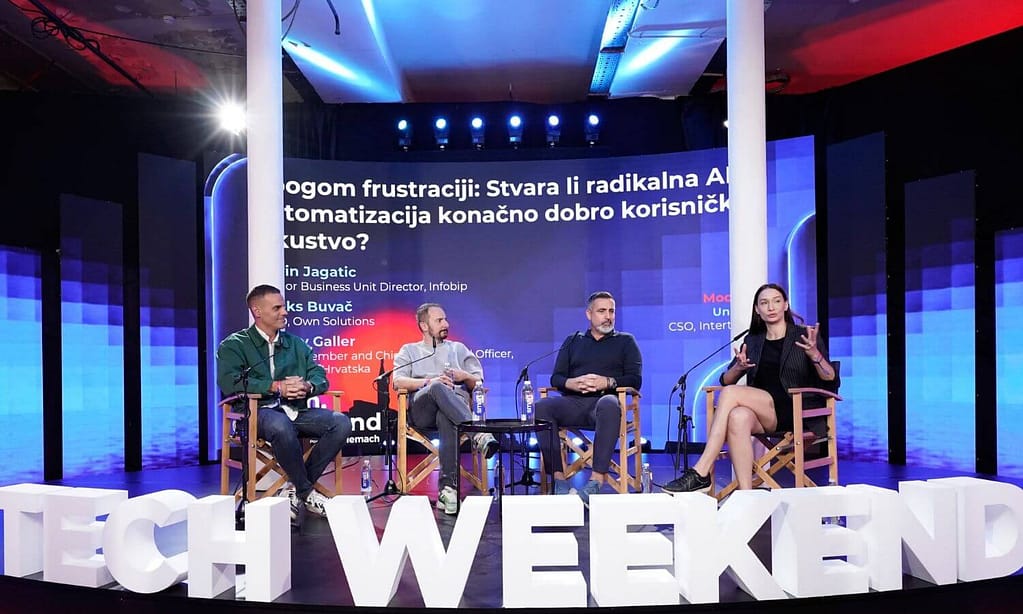
It opened with a finding that nobody in customer service was set up to notice. In an analysis of 100,000 conversations with an AI assistant, the single most common word users typed was “thank you”.
The industry has spent years measuring the opposite: abandonment rates, escalations, repeat contacts, sentiment scores. Nobody counts gratitude, mostly because nobody expected any. Buvač reported the same thing from his own deployment, saying the message users sent most often to Barba, the assistant his company built for the Croatian ferry operator Jadrolinija, was thank you, right through the summer season.
From there the discussion turned to what AI can now do in customer service and where it has to be held back, covering everything from confidential data to the standard of service a company is willing to put its name to.
Nobody should notice it is there
Jagatić argued that companies should get AI working inside the business before they put it anywhere near a customer, and that once they do, the customer should never notice the technology at all.
Infobip has gone further than most on the first part. In an interview with debug.hr in August 2026, Jagatić put company-wide adoption of AI tools at around 90%, with more than 1,600 employees actively building on an internal platform running at 99.4% availability, a figure he compared to critical production systems in telecoms. A new agent, he said, can be in production in about two minutes.
There is a reason the internal version is easier. Colleagues know roughly what the system can do, they can usually tell when it has got something wrong, and they have someone to complain to. Customers have none of that.
The second half of his argument cuts against how most companies behave. Deployments get announced, badged and labelled as AI-powered. On Jagatić’s view, if the customer is thinking about the technology at all, something has already gone wrong.
The same interview noted that Infobip is the only company from the region in the Agentic AI Foundation, among roughly 150 members, working on agent security, identity and reliability, and contributing its own experience with how well models handle smaller languages.
Two things arriving at once
Galler put the less comfortable half: AI brings democratisation and frustration at the same time, and a company does not get to deal with only the pleasant one.
He was the one panellist running customer experience as a department rather than selling it as a product. As a board member and Chief Commercial Officer at Telemach Hrvatska, his remit covers B2C, B2B, commercial support and the customer experience function.
The democratisation is easy enough to see across the sector. Round-the-clock cover in several languages used to require a large multilingual contact centre and the budget to staff it. Operators that could never have afforded that now have a version of it.
The frustration comes out of the same system rather than a separate one. Whatever answers a customer at three in the morning is also whatever will state a wrong billing date with perfect fluency.
That is what makes this different from the last round of automation. A phone menu was annoying, but it was honest about its limits. A fluent assistant that is wrong gives no warning whatsoever.
Where the line gets drawn
Buvač supplied the field cases. Own.Solutions is based in Rijeka and employs fewer than twenty-five people, but its client list runs from a ferry operator through the financial sector to a sports club.
Barba is the one people have heard of. It went live for Jadrolinija in late May 2026, just before the season started. Jadrolinija carries something like twelve million passengers a year, almost all of them crammed into a few weeks, which is exactly when a support line is least able to cope.
A good deal of the conversation about limits sat here: which data an assistant is allowed near, and how good the answers have to be before anyone lets it face the public. In regulated industries that line is drawn by someone else entirely.
Asked about a technology whose direction nobody can confidently predict, Buvač was blunt. It is important, he said, to be on that train:
“It’s important to be on that train.” — Aleks Buvač
That describes a lot of companies in the region at the moment. Nobody is sure where the train is going, but standing on the platform is not much of a plan either.
What the thank you was for
None of this means customers have warmed to automation. Consumer research has mostly gone the other way over the past two years, with the share of people who would rather speak to a human rising rather than falling.
The finding is narrower than it looks. What people seem to be responding to is not speed but the sense that the thing got sorted. For a passenger standing on the dock in August, the realistic alternative to Barba was a phone that nobody answered.
Which puts the panel’s title in a different light. Automation on its own does not produce good customer experience. It removes one sort of friction, the waiting and the language and the limited hours, and introduces another in the form of confident mistakes and limits nobody has explained. Which of the two wins depends almost entirely on where the boundaries sit and whether anyone gets left halfway.
On the evidence of one Adriatic summer, people do not mind the machine nearly as much as they mind being abandoned partway through a problem. When they were not, a surprising number of them said thank you.
The panel ran in Croatian as “Zbogom frustraciji: Stvara li radikalna AI automatizacija konačno dobro korisničko iskustvo?” at Tech.Weekend, part of Weekend.19 in Rovinj, 24–27 September 2026.