


Capital Reimagined: Future-Proofing the Old and Accelerating the New was a panel held on 26 September 2026 at Tech.Weekend, part of the Weekend.19 festival in Rovinj. The Tech.Weekend program ran to sixteen panels that year, most of them on AI agents, robotics and engineering. This one was about ownership.
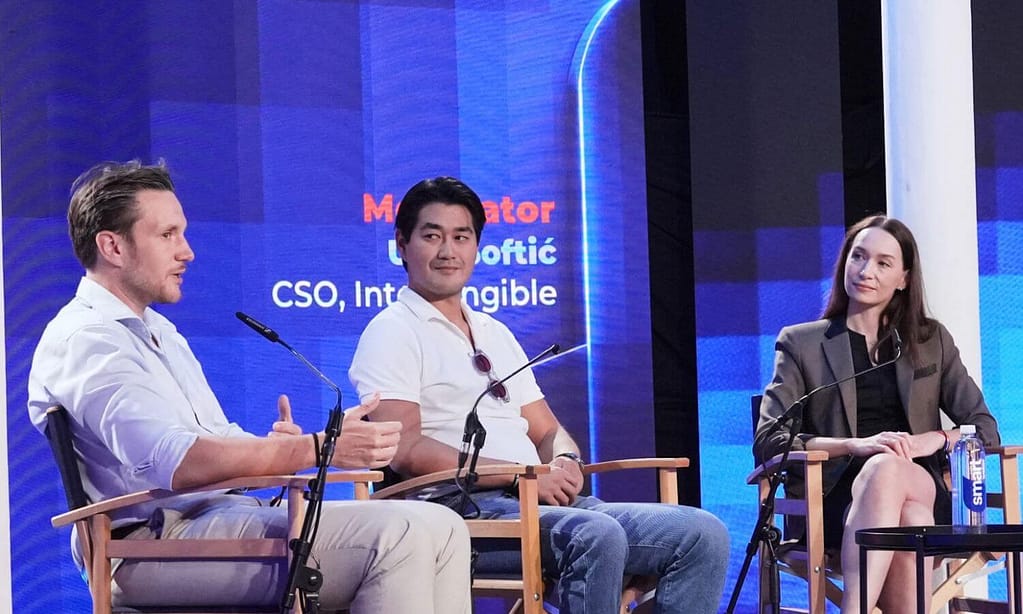
The speakers were Tsukasa Kikuchi, Operations Lead at Teamshares in New York, and Janos Barberis, CEO and co-founder of Supercharger Ventures. Una Softić, CSO at Intertangible, moderated. The stated subject was new models of investment, ownership and long-term value creation, which in practice meant two men describing the same gap in the market from opposite sides of it.
A good deal of the discussion went to family-owned and traditional businesses facing succession, and to the problem of explaining newer ownership-transfer models to the people who built those companies. Barberis works with founders outside the big financial capitals. Kikuchi’s company buys small businesses from owners who want to retire.
Those sound like different businesses, and they are. The complaint underneath them turned out to be roughly the same one.
The businesses nobody buys
Teamshares cites a figure on its own site that explains most of what it does: roughly 70% of small businesses that go up for sale never find a buyer.
These are not failing companies. A firm turning over a few million dollars with twenty staff is simply too small for private equity to bother with and too ordinary to interest venture capital, and it usually depends heavily on one person who now wants to stop working. When that person retires, the business tends to close with them.
Teamshares buys those companies outright and then gives them away, slowly. Employees get 10% of the stock at closing without paying anything for it, and that share climbs toward 80% over twenty years. The retiring owner is paid out. A new president is recruited and trained to run the place. The company stays where it is, and under the terms of the model it does not get sold again.
Private equity is built the other way round. There is an exit to engineer, a clock running, and a multiple to push up before the next sale. Teamshares has none of that, so the money has to come from the business simply working for a long time.
What Kikuchi chose to stress on the panel was not the transaction but everything around it:
“Passive acquisition is a way of creating value and wealth over the long term. That’s why educating business owners is an important part of the whole process.” — Tsukasa Kikuchi
That emphasis makes sense once you picture the conversation. Persuading a sixty-year-old owner that selling to his own staff is a real exit takes a while, and teaching that staff what a share certificate actually entitles them to takes longer still. Teamshares runs financial education as part of the model rather than as an add-on.
The founders nobody funds properly
Barberis arrived at the same gap from the other side, through what happens to founders who are nowhere near a major financial capital.
The venture playbook was written in a few specific cities and quietly assumes what those cities provide: plenty of follow-on money, a large market next door, buyers who know how to acquire a startup, and enough comparable exits that a valuation means something to the next investor along.
Run the same advice somewhere those things are missing and nothing obvious breaks. Founders raise bigger rounds, chase growth and put off profitability, in markets that will not pay them back for any of it. The advice was never wrong in California. It just does not travel.
Barberis has been working on this for a decade or more. The cohorts from his earlier accelerator produced 49 startups that went on to raise over $500 million, none of them built in the places the playbook was written for.
Reimagining capital, on that reading, has less to do with inventing new instruments than with giving up a borrowed definition of what success looks like.
Does equity still work?
Both models lean on the same instrument, which makes the comparison worth drawing out.
Founder equity is a long bet on a large outcome, held by very few people. Employee stock in a plumbing supplier is a small, steady claim on a company that has promised never to sell. Legally these are close cousins. In every other respect they have little to do with each other.
Equity remains the strongest alignment tool anyone has come up with, because it links what someone does today to what the company is worth later without needing a manager in the middle. It is also a crude one. It tends to reward whoever happened to be there early rather than whoever is doing the work now, it locks people in for years, and in a business that will never be sold, the value has to be generated rather than cashed out.
Teamshares deals with part of that by paying dividends alongside the stock, so ownership returns something long before it returns everything. Venture has no clean equivalent, which is one reason the argument about secondaries keeps coming back.
For now equity holds its position. Whether it keeps it was left open.
Why it matters here
The festival’s own account of the session says the speakers looked at how to support new business ideas while also keeping existing companies going for the generations that follow. The second half of that has a clock on it.
Teamshares exists because of a specific American problem: a large cohort of small business owners reaching retirement with no obvious successor, running companies too small for anyone conventional to buy.
Whether the model would work in this part of Europe is genuinely unsettled. It would depend on company law, on how employee shareholding is taxed, on whether local banks will finance deals of that shape, and on how owners react to the idea of ownership being shared rather than handed down.
Which brings the education point back round. A mechanism nobody has heard of is not really an option, however well it performs on paper.
The succession problem turns up either way.
Where the money went quiet
For twenty years the answer to where value gets created has been more or less fixed: software, platforms, scale, the hubs.
What both speakers described, coming at it from different directions, was a drift away from all that. Toward businesses that are physical and emotionally charged, toward retail and hospitality where the product cannot be delivered down a wire, and toward smaller markets instead of the deeptech and fintech capitals that have soaked up most of the attention.
Technology has not stopped mattering. The interesting ownership questions have just moved to places where the asset is a building, a route, a customer relationship, or forty people who know how to do something well.
A panel about capital, at a festival about technology, in a town that lives off hospitality. The venue had made the argument before anyone sat down.
Capital Reimagined: Future-Proofing the Old and Accelerating the New ran at Tech.Weekend, part of Weekend.19 in Rovinj, 24–27 September 2026. Moderated by Una Softić, CSO at Intertangible.