


Money Motion · Bled · September 2026
AI agents are everywhere. ROI isn’t.
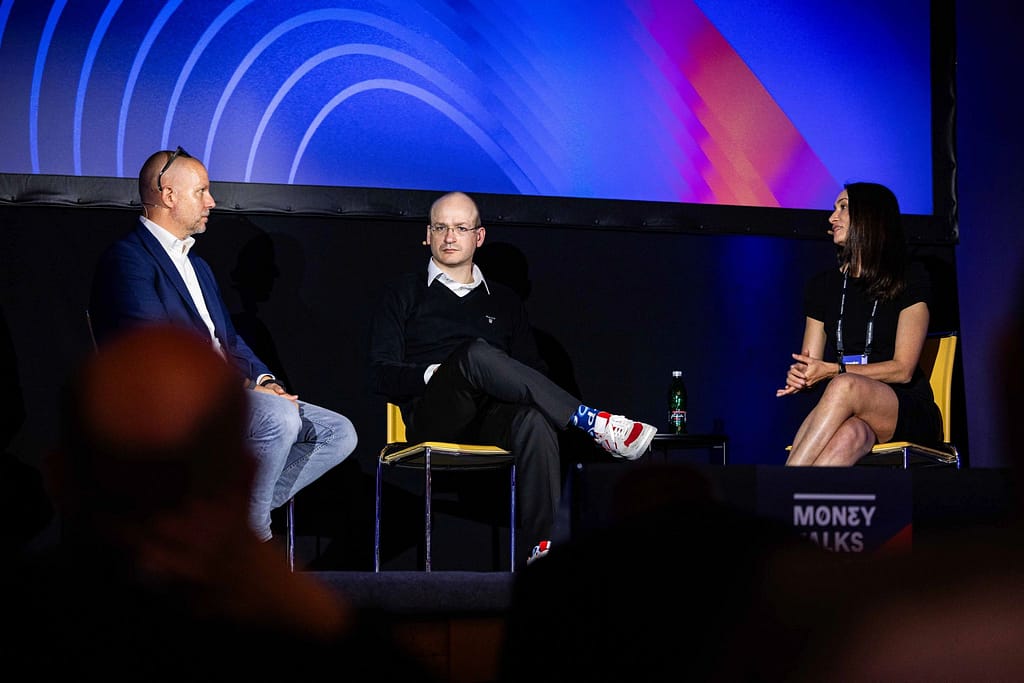
That was the implicit challenge running through The AI-Driven Bank — Cost-Cutting to Core Transformation, a panel at Money Motion in Bled that brought together Vedran Bajer, General Manager for the Adriatic, Hungary and the Baltics at Wonderful, and Reinhard Höll, Chief Transformation Officer and Management Board member at NLB Group, and our own Una Softic.
The panel was designed around a simple provocation: the banking industry has spent years talking about AI transformation. Most of it is still on paper. The conversation that followed was one of the more honest ones you will hear at a conference, partly because the three people on stage have spent enough time inside real institutions to know what actually breaks, and partly because Softic, with an academic background in natural language processing and firsthand experience deploying AI systems inside financial institutions, was not the kind of moderator content to let a good talking point go untested.
ROI: Separating Real Returns from Hope
“The gap between having AI and benefiting from AI is the defining challenge of this moment.”
Höll was asked to share insights first, and his answer set the tone for the panel: useful, specific, and notably free of the varnish that tends to coat executive answers at public events. He drew a distinction between AI use cases that are generating measurable returns today and those that are still, in his own phrase, “in the hope column.” For NLB, the honest returns are concentrated in back-office automation, digital onboarding speed, and call centre deflection,areas where the input-output relationship is clear and the measurement is relatively straightforward. The revenue upside, he acknowledged, is a longer and less certain story.
Bajer, speaking from the vendor side, was pressed on Wonderful’s headline claim: AI agents deployed inside enterprises in 48 hours. Softic pushed on the gap between that figure and the reality of a mid-size regional bank running 15-year-old core infrastructure across multiple regulatory jurisdictions. The exchange was the panel’s first genuinely uncomfortable moment, and the more useful for it. The 48-hour figure, it emerged, reflects the speed of a standard deployment into a prepared environment. The journey from that to full production inside a legacy institution is measured in months, not days.
The panel’s most electric exchange came when Softic turned the question directly: does NLB use Wonderful, or would it? The answer was diplomatic. But the fact that the question told the audience more about the real buyer-vendor dynamic in regional enterprise AI than any case study would have.
Legacy Integration: Where Ambition Meets Architecture
If the ROI conversation was about what AI is delivering, the integration conversation was about why it is so hard to deliver at scale.
Höll has a specific public target: 90% of NLB’s new regular transactions originated end-to-end digitally. He was asked, simply, what the number is today, and what the single biggest technical barrier is between here and there. His answer (hybrid-cloud migration, API layering over legacy cores, data architecture) was not surprising. What was notable was the framing: this is not a technology problem that will be solved by better technology. It is a sequencing problem, a governance problem, and above all a time problem. These systems took decades to build. They will not be replaced in a product cycle.
Softic brought her NLP background into the conversation at this point in a way that reframed the entire integration question. “This is a language problem as much as a systems problem,” she observed. “When an AI agent needs to pull data from four different backend systems to answer one customer question, it is being asked to translate between four different data schemas. That is a form of multilingualism that most platforms underestimate.”
Bajer was then asked the harder version of the localization question. Wonderful’s positioning rests on AI that “speaks the language and culture” of the markets it serves. But the Adriatic is not a monolith. Regional institutional registers, legal vocabularies, and conversational relationships to authority are diverse. Who validates the cultural layer, and how? Softic pushed the conversation past the marketing register into the operational one.
Risk, Governance, and Who Is Liable When the Agent Is Wrong
The third section of the panel was the one the compliance and risk professionals in the room had been waiting for.
The scenario Softic put to both speakers was specific: an AI agent handles a mortgage complaint, gives wrong advice, and the customer suffers a financial loss. Who is liable — the bank that deployed the agent, the vendor that built it, or the model that generated the response?
Höll’s answer presented an enormous burden on the governance layer between the vendor’s capability and the bank’s accountability, and that layer, in most institutions, is still being built in real time.
Softic brought her Intertangible conversational AI experience into this section briefly but pointedly. When AI-fronted banking advisors were first deployed in production environments the rule was non-negotiable: a digital interface could inform but could not advise on regulated products. The question she posed to both panellists was whether that boundary still holds as agentic AI becomes more capable and more autonomous. Neither answer was fully satisfying. Which is probably the correct state of affairs.
Future of Work: The Question the Audience Came For
The panel ended where every AI panel in financial services eventually ends, and where most of them are least honest: the workforce.
Höll was asked directly. NLB has more than 8,000 employees across Southeast Europe. If the transformation works exactly as planned — 90% of transactions digitised, back office automated, agile operating model embedded — what does that mean for headcount in five years? And how do you look someone in a back office in Belgrade or Skopje in the eye and ask them to help build it?
His answer stayed close to the standard executive framing: AI is about redeployment, not replacement; new roles emerge; the institution’s obligation is to invest in the transition. What distinguished it from the usual performance of this answer was his willingness to name the difficulty of it — the paradox of asking the people most at risk from a transformation to be its most active participants.
Bajer was given the harder version of the same question. Wonderful’s value proposition to enterprise clients is, at its core, an efficiency story: the same customer volume handled by fewer people at lower cost. That is a displacement story with better branding. He was asked whether the distinction matters to him. His answer — that the capability uplift for the people who remain is the more important story — was reasonable. Whether it is the complete story is a different question.
Softic closed this section with an observation drawn from her time advising in Japan. SBI Holdings, one of Japan’s largest financial groups and the parent company of CoinPost, is not reducing headcount as it deploys AI and digital infrastructure across its operations. It is changing the composition of its workforce — the mix of skills, the nature of the roles, the relationship between human judgment and automated execution. The question she posed to the room was not how many people, but which people: which capabilities become more valuable as AI handles more of the routine, and which institutions are investing in that transition now rather than managing it reactively later.
What the Panel Left Behind
Three things stayed in the room after the panel ended.
The first is that the honest ROI conversation in banking AI is still being had too quietly. The institutions that are generating real returns — JPMorgan, Morgan Stanley, Goldman Sachs — are doing so at a scale and with a technology budget that makes direct comparison to a regional bank in Southeast Europe difficult. The panel was most useful when it named that gap rather than papering over it.
The second is that the localization question is more technically serious than it is usually treated. Wonderful’s case rests on the claim that AI can serve the cultural and linguistic specificity of regional markets in a way that global platforms cannot. That claim is worth testing — not to disprove it, but because the institutions being asked to stake their customer relationships on it deserve a precise answer, not a compelling one.
The third is that the governance layer is the thing nobody has fully built yet. The EU AI Act is coming into full high-risk enforcement in August 2026. The OCC’s model risk framework explicitly excludes generative and agentic AI from its scope. The IMF has flagged that current regulations cannot reliably assign liability when an agent misdirects a payment. The banks that will navigate the next three years well are the ones building that governance infrastructure now — not as a compliance exercise, but as the foundation on which everything else depends.
Höll, who has made “remaining PowerPoint” his shorthand for transformations that look serious and aren’t, would put it more simply: the test is not what you have committed to. It is what you have changed.